API Courses
API courses can help you learn how to design, build, and test application programming interfaces, as well as understand RESTful services and authentication methods. You can build skills in data exchange formats like JSON and XML, error handling, and API documentation practices. Many courses introduce tools such as Postman for testing APIs, Swagger for documentation, and various programming languages like Python or JavaScript to implement API calls, allowing you to effectively integrate and manage data across different systems.
Popular API Courses and Certifications

Skills you'll gain: API Testing, Postman API Platform, OAuth, Application Programming Interface (API), Performance Testing, Security Testing, Software Testing, Test Tools, Authentications, Scenario Testing

Skills you'll gain: JSON, Restful API, HTML and CSS, Web Design, Web Design and Development, Cloud API, Hypertext Markup Language (HTML), Web Development, Application Programming Interface (API), Cascading Style Sheets (CSS), Web Applications, Real Time Data, Javascript

Skills you'll gain: OpenAI API, Prompt Engineering, Generative AI Agents, Data Analysis, Generative AI, OpenAI, Data Visualization Software, Data Manipulation, Artificial Intelligence, Python Programming
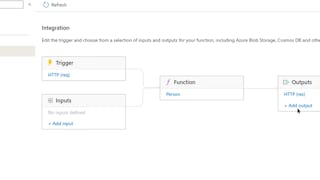
Skills you'll gain: API Gateway, Serverless Computing, Cloud API, Restful API, Node.JS, Microsoft Azure, Application Programming Interface (API), API Design, API Testing, Software Testing, Network Routing
Skills you'll gain: Restful API, API Design, Application Programming Interface (API), Security Controls, Virtual Environment, Development Environment, Python Programming, Secure Coding, Data Access, User Accounts, Package and Software Management, Application Security, Encryption

What brings you to Coursera today?
Skills you'll gain: OpenAI API, ChatGPT, Prompt Engineering, OpenAI, AI Integrations, LLM Application, Python Programming
Skills you'll gain: Node.JS, Restful API, API Design, Server Side, Application Programming Interface (API), Back-End Web Development, Microsoft Visual Studio, Web Applications, Javascript, Application Development, Integrated Development Environments
Skills you'll gain: Cloud API, Application Programming Interface (API), API Design, Cloud Services, C# (Programming Language), Server Side, Application Development, Development Environment
Skills you'll gain: Restful API, Cloud API, Application Programming Interface (API), Postman API Platform, API Design, API Testing, Java Programming, Java, Mobile Development, Apache Maven, Application Development, Data Access, Web Development, Eclipse (Software), Software Design
Skills you'll gain: API Testing, JSON, Test Automation, Test Script Development, Application Programming Interface (API), Restful API, Software Testing, Test Tools, Integration Testing, Functional Testing

Skills you'll gain: API Testing, Application Programming Interface (API), Test Tools, Behavior-Driven Development, Test Automation

Skills you'll gain: Prompt Engineering, OpenAI API, Generative AI, Exploratory Data Analysis, Analysis, OpenAI, ChatGPT, Data Analysis, Analytics, Data-Driven Decision-Making, E-Commerce, Data Manipulation, Python Programming
What brings you to Coursera today?
Best Api courses from Coursera
Top-rated Api courses offered by Coursera on Coursera.
- API Testing a real web application via PostmanCourseraBeginnerLess Than 2 HoursCoursera
- Build a Website using an API with HTML, JavaScript, and JSONCourseraIntermediateLess Than 2 HoursCoursera
- GenAI for Data Analysis : OpenAI Assistant APICourseraIntermediateLess Than 2 HoursCoursera
Best Api courses for beginners
Top-rated beginner-friendly Api courses with no prerequisites.
- Azure: create a REST API using NodeJS Serverless FunctionsCourseraBeginnerLess Than 2 HoursNo prerequisites
- API Testing Using Rest Assured Test Automation ToolCourseraBeginnerLess Than 2 HoursNo prerequisites
- API Testing with Karate FrameworkCourseraBeginnerLess Than 2 HoursNo prerequisites
Best short Api courses
Quick Api courses you can complete in a few hours or less.
- Configuración de APIs en Python: Crea un API RESTCourseraIntermediateLess Than 2 HoursQuick completion
- OpenAI API for Beginners: Create AI Assistants with ChatGPTCourseraIntermediateLess Than 2 HoursQuick completion
- APIs in Node.js: Write a RESTful API Backend ApplicationCourseraIntermediateLess Than 2 HoursQuick completion










