Blockchain Courses
Blockchain courses can help you learn how distributed ledgers record transactions, verify data, and support decentralized systems. You can build skills in understanding consensus mechanisms, smart contract basics, and evaluating blockchain use cases across different industries. Many courses introduce tools such as block explorers, development frameworks, and platforms used to experiment with blockchain applications.
Popular Blockchain Courses and Certifications
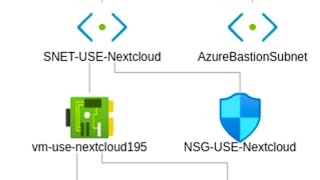 Status: Free
Skills you'll gain: Virtual Machines, Microsoft Azure, Infrastructure As A Service (IaaS), Cloud Infrastructure, Cloud Computing Architecture, Virtualization and Virtual Machines, Cloud Deployment, Firewall, Cloud Computing, Network Security, Virtual Networking, Web Servers, Network Administration, Remote Access Systems, Application Deployment

Skills you'll gain: Blockchain, Application Deployment, Integrated Development Environments, Development Testing, Web Development Tools, Program Development, Cryptographic Protocols, Javascript, Scripting
 Status: Free
Skills you'll gain: Microsoft Azure, Data Visualization, Microsoft Excel, Interactive Data Visualization, Internet Of Things, Cloud Storage, Data Storage Technologies, Data Import/Export, Data Pipelines
 Status: Free
Skills you'll gain: Microsoft Azure, Virtual Machines, Data Storage Technologies, Cloud Storage, Cloud Computing, Virtualization and Virtual Machines, Disaster Recovery, Cloud Management, Cloud Infrastructure, Cloud Services
 Status: Free
Skills you'll gain: Sprint Planning, Azure DevOps, Backlogs, Collaborative Software, Issue Tracking, Kanban Principles, Agile Software Development, Microsoft Azure, Project Management, DevOps

What brings you to Coursera today?
 Status: Free
Skills you'll gain: Application Programming Interface (API), Microsoft Azure, Cloud API, Computer Vision, Artificial Intelligence and Machine Learning (AI/ML), User Accounts, Image Analysis, Artificial Intelligence, Cloud Computing, Software Development
Coursera
Skills you'll gain: Terraform, Infrastructure as Code (IaC), Infrastructure As A Service (IaaS), Microsoft Azure, Cloud Infrastructure, IT Automation, DevOps
 Status: Free
Skills you'll gain: Model Deployment, Decision Tree Learning, Applied Machine Learning, Predictive Modeling, Machine Learning Software, Microsoft Azure, No-Code Development, Machine Learning, Data Preprocessing, Predictive Analytics, Model Training, Cloud Deployment, Feature Engineering, Machine Learning Algorithms, Model Evaluation, Data Science, Data Analysis, Classification Algorithms
 Status: Free
Skills you'll gain: API Gateway, Serverless Computing, Cloud API, Restful API, Node.JS, Microsoft Azure, Application Programming Interface (API), API Design, API Testing, Software Testing, Network Routing
Skills you'll gain: Microsoft Azure, Unsupervised Learning, Applied Machine Learning, Predictive Modeling, Model Deployment, Data Transformation, Model Evaluation, Exploratory Data Analysis, Data Processing, Machine Learning Algorithms, Machine Learning, Artificial Intelligence and Machine Learning (AI/ML), Cloud Computing, User Accounts
Skills you'll gain: Data Mapping, Microsoft Azure, Data Transformation, Data Pipelines, Extract, Transform, Load, Dataflow, Data Processing, Data Integration, Data Storage, Cloud Storage
 Status: Free
Skills you'll gain: Azure Synapse Analytics, Microsoft Azure, Data Lakes, Cloud-Based Integration, Transact-SQL, Data Integration, Cloud Storage, File Management
What brings you to Coursera today?
In summary, here are 10 of our most popular blockchain courses
- Azure: Create a Virtual Machine and Deploy a Web Server: Coursera
- Solidity for Beginners: Write and Test Smart Contracts: Coursera
- Getting started with Azure IOT Hub: Coursera
- Implementing Microsoft Azure Backup: Coursera
- Getting Started with Azure DevOps Boards: Coursera
- Build a computer vision app with Azure Cognitive Services: Microsoft
- Terraform for absolute beginners: Coursera
- Machine Learning Pipelines with Azure ML Studio: Coursera
- Azure: create a REST API using NodeJS Serverless Functions: Coursera
- Develop Clustering Models with Azure ML Designer: Microsoft










