Build NLP Skills with Projects
NLP projects can help you learn text processing, sentiment analysis, language modeling, and chatbot development. You can build skills in data preprocessing, feature extraction, and model evaluation techniques. Many courses introduce tools like Python, NLTK, and TensorFlow, that support implementing NLP algorithms and deploying AI applications effectively.
Full List of NLP Projects

Skills you'll gain: Transfer Learning, Fine-tuning, Tensorflow, Natural Language Processing, Keras (Neural Network Library), Embeddings, Model Training, Deep Learning, Classification Algorithms, Model Evaluation, Machine Learning

Skills you'll gain: Prompt Engineering, ChatGPT, Patient Communication, Generative AI, Artificial Intelligence, Natural Language Processing

Coursera
Skills you'll gain: Model Evaluation, Model Training, Exploratory Data Analysis, Data Cleansing, Scikit Learn (Machine Learning Library), Probability & Statistics, Natural Language Processing, Data Preprocessing, Data Analysis, Classification Algorithms, Python Programming, Machine Learning, Automation
Skills you'll gain: Embeddings, PyTorch (Machine Learning Library), Artificial Neural Networks, Deep Learning, Model Training, Computer Vision
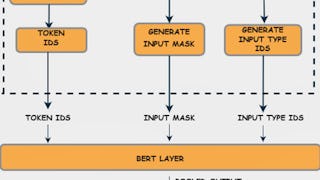
Skills you'll gain: Fine-tuning, Tensorflow, Keras (Neural Network Library), Model Training, Model Evaluation, Natural Language Processing, Data Preprocessing, Deep Learning, Data Pipelines
What brings you to Coursera today?
Skills you'll gain: Tensorflow, Keras (Neural Network Library), Data Synthesis, Model Training, Convolutional Neural Networks, Computer Vision, Artificial Neural Networks, Model Evaluation, Deep Learning, Machine Learning
Skills you'll gain: Recurrent Neural Networks (RNNs), Tensorflow, Python Programming, Model Training, Natural Language Processing, Data Preprocessing, Artificial Neural Networks, Deep Learning, Classification Algorithms, Machine Learning

Skills you'll gain: Cloud API, Google Cloud Platform, Application Programming Interface (API), Generative AI, Natural Language Processing, Python Programming
Skills you'll gain: Model Evaluation, ChatGPT, Fine-tuning, Keras (Neural Network Library), Model Training, Model Optimization, Applied Machine Learning, Data Preprocessing, Image Analysis, Data Import/Export, Test Data, Machine Learning, Python Programming, Artificial Neural Networks

Skills you'll gain: Recurrent Neural Networks (RNNs), Exploratory Data Analysis, Deep Learning, Plot (Graphics), Artificial Neural Networks, Data Cleansing, Data Import/Export, Data Analysis, Data Preprocessing, Natural Language Processing, Model Training, Applied Machine Learning, Python Programming, Machine Learning, Automation

Skills you'll gain: IBM Cloud, Application Deployment, Customer Inquiries, Customer Engagement, Cloud Computing, Customer Service, Natural Language Processing

Best free Nlp courses
High-quality free Nlp courses you can start today.
- Transfer Learning for NLP with TensorFlow HubCourseraIntermediateLess Than 2 HoursFree
- Deep Learning with PyTorch : Siamese NetworkCourseraAdvancedLess Than 2 HoursFree
- Fine Tune BERT for Text Classification with TensorFlowCourseraIntermediateLess Than 2 HoursFree
Best Nlp courses from Coursera
Top-rated Nlp courses offered by Coursera on Coursera.
- ChatGPT Playground for Beginners: Intro to NLP AICourseraBeginnerLess Than 2 HoursCoursera
- NLP: Twitter Sentiment AnalysisCourseraBeginnerLess Than 2 HoursCoursera
- Object Localization with TensorFlowCourseraIntermediateLess Than 2 HoursCoursera
Best Nlp courses for beginners
Top-rated beginner-friendly Nlp courses with no prerequisites.
- Fake News Detection with Machine LearningCourseraBeginnerLess Than 2 HoursNo prerequisites
- Building Smart Business Assistants with IBM WatsonCourseraBeginnerLess Than 2 HoursNo prerequisites
- Medical Insurance Premium Prediction with Machine LearningCourseraBeginnerLess Than 2 HoursNo prerequisites
Best short Nlp courses
Quick Nlp courses you can complete in a few hours or less.
- Tweet Emotion Recognition with TensorFlowCourseraIntermediateLess Than 2 HoursQuick completion
- Generative AI with Vertex AI: Build a customer chatbotCourseraIntermediateLess Than 2 HoursQuick completion
- Machine Learning with ChatGPT: Image Classification ModelCourseraIntermediateLess Than 2 HoursQuick completion