Political Science Courses
Political Science courses can help you learn about government structures, political theories, international relations, and public policy analysis. You can build skills in critical thinking, data interpretation, and effective communication, that support analyzing political systems and crafting informed arguments. Many courses introduce tools like statistical software for analyzing political data, simulation models for understanding electoral processes, and case study methods to evaluate policy impacts.
Popular Political Science Courses and Certifications

Yale University
Skills you'll gain: Political Sciences, Policy Analysis, Social Justice, Social Studies, Public Policies, Economics, Policy, and Social Studies, Social Sciences, Law, Regulation, and Compliance, Governance, Sociology, Ethical Standards And Conduct, Liberal Arts, Socioeconomics, Economics

University of London
Skills you'll gain: Diplomacy, International Relations, Emergency Response, Crisis Intervention, Sustainable Development, Political Sciences, Public Policies, Social Justice, Public Safety and National Security, Governance, Advocacy, Policy Analysis, World History
Utrecht University
Skills you'll gain: Lobbying, Social Justice, Political Sciences, Economics, Policy, and Social Studies, Socioeconomics, Tax Laws, Civil Law, Social Sciences, Economics, Policy Analysis, Public Affairs, Liberal Arts, Public Policies, Governance, International Finance

Università di Napoli Federico II
Skills you'll gain: Political Sciences, Critical Thinking, Case Studies, Research, Social Sciences, Governance, Sociology, Interactive Learning, Public Administration, Research Methodologies

University of Michigan
Skills you'll gain: Policy Analysis, Research, and Development, Community Organizing, Policy Development, Social Justice, Social Work, Public Policies, Sustainable Development, Sustainable Systems, Community Development, Community and Social Work, Political Sciences, Health Policy, Advocacy, Social Impact, Economics, Policy, and Social Studies, Policy Analysis, Sustainable Business, Strategic Leadership, Systems Thinking, Cultural Diversity
What brings you to Coursera today?
Johns Hopkins University
Skills you'll gain: Political Sciences, Policy Analysis, Social Studies, Social Justice, Public Affairs, Mathematics and Mathematical Modeling, Social Sciences, Public Policies, Game Theory, Demography, Mathematical Modeling, Governance, Decision Intelligence, Combinatorics, General Mathematics, Diversity Awareness, Applied Mathematics

Sage Publications
Skills you'll gain: Statistical Reporting, Regression Analysis, Research Reports, Report Writing, Statistical Inference, SPSS, Data Presentation, Quantitative Research, Statistical Methods, Statistical Analysis, Data Analysis, Statistical Software, Statistical Modeling, Logistic Regression, Political Sciences, Research, Research Methodologies, SPSS (Software), Data Visualization, International Relations

Pearson
Skills you'll gain: Social Studies, Sociology, Culture, Economics, Policy, and Social Studies, Gerontology, Community Organizing, Social Justice, Social Sciences, Political Sciences, Cultural Diversity, Demography, Research, Research Methodologies, Socioeconomics, Cultural Responsiveness, Qualitative Research, International Relations, Social Impact, Diversity Awareness, Cultural Sensitivity

Pearson
Skills you'll gain: Social Studies, Economics, Policy, and Social Studies, Political Sciences, Social Sciences, International Relations, Socioeconomics, Economics, Public Policies, Sociology, World History, Public Safety and National Security, Policy Analysis, Economic Development, Systems Thinking, Organizational Structure

University of Amsterdam
Skills you'll gain: Qualitative Research, Scientific Methods, Statistical Analysis, Statistical Hypothesis Testing, Research, Science and Research, Research Design, Sampling (Statistics), Research Reports, Interviewing Skills, Data Analysis, Data Collection, Research Methodologies, Probability & Statistics, Social Sciences, Statistical Methods, Regression Analysis, Statistical Inference, Statistics, R Programming

Sage Publications
Skills you'll gain: SPSS, SPSS (Software), Social Sciences, Political Sciences, Data Entry, Data Literacy, Research, Descriptive Statistics, Research Methodologies, Data Analysis, Science and Research, Statistical Analysis, Statistical Methods, Research Design, Statistical Software, Statistics, Quantitative Research, International Relations, Data Visualization, Statistical Inference


Università di Napoli Federico II
Skills you'll gain: International Relations, Political Sciences, Social Studies, Social Sciences, Diplomacy, World History, Governance, Environmental Issue, Cultural Diversity, Research Methodologies, Public Safety and National Security, Economics, Security Strategy, Conflict Management
Best free Political Science courses
High-quality free Political Science courses you can start today.
- Moral Foundations of PoliticsYale UniversityMixed1 - 3 MonthsFree
- Global Diplomacy: the United Nations in the WorldUniversity of LondonBeginner1 - 3 MonthsFree
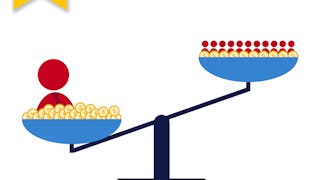
- Inequality and DemocracyUtrecht UniversityBeginner1 - 3 MonthsFree
Best Political Science courses from Università di Napoli Federico II
Top-rated Political Science courses offered by Università di Napoli Federico II on Coursera.
- Understanding Political ConceptsUniversità di Napoli Federico IIBeginner1 - 4 WeeksUniversità di Napoli Federico II
- Global PoliticsUniversità di Napoli Federico IIBeginner1 - 4 WeeksUniversità di Napoli Federico II
Best Political Science certificate programs
Earn a certificate in Political Science from top universities and companies.
- Social Impact & Public PolicyUniversity of MichiganBeginner3 - 6 MonthsSpecialization
- Introduction to SociologyPearsonBeginner1 - 3 MonthsSpecialization
- Methods and Statistics in Social SciencesUniversity of AmsterdamBeginner3 - 6 MonthsSpecialization
Best Political Science courses for beginners
Top-rated beginner-friendly Political Science courses with no prerequisites.
- Advanced Statistical Reporting for Political ScienceSage PublicationsBeginner1 - 4 WeeksNo prerequisites
- The Economy and PoliticsPearsonBeginner1 - 4 WeeksNo prerequisites
- Statistical Analysis in Political Science with SPSSSage PublicationsBeginner1 - 4 WeeksNo prerequisites










