Satellite Courses
Satellite courses can help you learn orbital mechanics, satellite communication systems, remote sensing techniques, and data analysis for satellite imagery. You can build skills in signal processing, geographic information systems (GIS), and project management for satellite missions. Many courses introduce tools like MATLAB for simulations, Python for data analysis, and specialized software for image processing, allowing you to apply your knowledge in practical scenarios such as developing satellite applications or analyzing environmental data.
Popular Satellite Courses and Certifications
University of Alaska Fairbanks
Skills you'll gain: Spatial Data Analysis, Geospatial Mapping, 3D Modeling, Real Time Data, Logistics, Human Factors, Object-Relational Mapping
Skills you'll gain: Spatial Data Analysis, Spatial Analysis, Random Forest Algorithm, Model Evaluation, Feature Engineering, Model Training, Matplotlib, Geospatial Information and Technology, Convolutional Neural Networks, Image Analysis, Applied Machine Learning, Plot (Graphics), Supervised Learning, Environmental Monitoring, Trend Analysis, Data Analysis, Geospatial Mapping, Deep Learning, Machine Learning, Geographic Information Systems
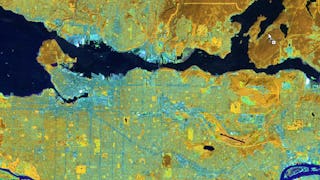
University of Toronto
Skills you'll gain: Geographic Information Systems, GIS Software, Spatial Analysis, Spatial Data Analysis, Data Manipulation
University of California, Davis
Skills you'll gain: ArcGIS, Spatial Data Analysis, GIS Software, Spatial Analysis, Data Storytelling, Geographic Information Systems, Datamaps, Data Presentation, Geospatial Mapping, Data Sharing, Public Health, Land Management, Heat Maps, Image Analysis, Project Management, Data Quality, Metadata Management, Network Analysis, Data Mapping, Data Modeling
University of Michigan
Skills you'll gain: Mechanics, Environmental Monitoring, Global Positioning Systems, Engineering, Physics, Environment, Physical Science, Cost Reduction, Engineering Calculations, Scientific Methods, World History, International Relations, Social Studies, Political Sciences
What brings you to Coursera today?
University of Colorado Boulder
Skills you'll gain: Control Systems, Mechanics, Torque (Physics), Simulation and Simulation Software, Numerical Analysis, Simulations, Engineering Analysis, Mathematical Modeling, Algorithms, Communication Systems, Physics, Calculus
Technical University of Munich (TUM)
Skills you'll gain: Global Positioning Systems, Human Factors, Manufacturing and Production, Manufacturing Processes, Digital Transformation, Digital Communications, Control Systems, Production Process, Automation, Leadership, Communication Systems, Robotics, Mathematical Modeling, Artificial Intelligence, Cyber Risk, Simulation and Simulation Software, Technology Strategies, AI Integrations, Model Optimization, Data Storage
University of Colorado Boulder
Skills you'll gain: Vibrations, Control Systems, Simulation and Simulation Software, Mechanics, Torque (Physics), Simulations, Differential Equations, Mathematical Modeling
L&T EduTech
Skills you'll gain: Geospatial Information and Technology, Spatial Analysis, GIS Software, Spatial Data Analysis, Geographic Information Systems, Geospatial Mapping, Construction Engineering, Database Management, Database Management Systems, Construction, ArcGIS, Relational Databases, Global Positioning Systems, Building Information Modeling, Network Analysis, Data Modeling, Software Installation, Open Source Technology, Classification Algorithms
Skills you'll gain: GIS Software, Model Evaluation, Geographic Information Systems, Extract, Transform, Load, Spatial Analysis, Spatial Data Analysis, Geospatial Mapping, Data Pipelines, Geospatial Information and Technology, Apache Airflow, Geostatistics, Interactive Data Visualization, Cloud Computing, Leaflet (Software), Google Cloud Platform, Environmental Monitoring, Model Training, Real Time Data, Pandas (Python Package), Python Programming

Università di Napoli Federico II
Skills you'll gain: Control Systems, Systems Architecture, Simulations, Global Positioning Systems, Mechanical Engineering, Data Integration, Business Intelligence

University of Colorado Boulder
Skills you'll gain: Control Systems, Machine Controls, Process Control, Embedded Systems, Embedded Software, Real Time Data, Laboratory Experience, Electronics, Electronic Hardware, Manufacturing Processes, Electrical Engineering, Electronic Systems, Hardware Design, Electronic Components, Torque (Physics), Display Devices, Schematic Diagrams, Design Specifications, Debugging
Best Satellite courses from University of Colorado Boulder
Top-rated Satellite courses offered by University of Colorado Boulder on Coursera.
- Spacecraft Dynamics and ControlUniversity of Colorado BoulderAdvanced3 - 6 MonthsUniversity of Colorado Boulder
- Advanced Spacecraft Dynamics and ControlUniversity of Colorado BoulderAdvanced1 - 3 MonthsUniversity of Colorado Boulder
- Embedding Sensors and MotorsUniversity of Colorado BoulderIntermediate3 - 6 MonthsUniversity of Colorado Boulder
Best Satellite certificate programs
Earn a certificate in Satellite from top universities and companies.
- Unmanned Aerial Systems: OperationsUniversity of Alaska FairbanksIntermediate3 - 6 MonthsSpecialization
- Satellite Imagery, Remote Sensing & Machine LearningCourseraIntermediate3 - 6 MonthsSpecialization
- Geographic Information Systems (GIS)University of California, DavisBeginner3 - 6 MonthsSpecialization
Best Satellite courses for beginners
Top-rated beginner-friendly Satellite courses with no prerequisites.
- Spatial Analysis and Satellite Imagery in a GISUniversity of TorontoBeginner1 - 3 MonthsNo prerequisites
- Rocket Science 101University of MichiganBeginner1 - 3 MonthsNo prerequisites
- Mastering Geospatial Data Science: From Beginner to ExpertCourseraBeginner3 - 6 MonthsNo prerequisites










