Engineering Courses
Engineering courses can help you learn design principles, project management, systems analysis, and problem-solving techniques. You can build skills in technical drawing, materials selection, and prototyping, along with understanding regulatory standards and sustainability practices. Many courses introduce tools such as CAD software for design, simulation programs for testing, and project management platforms to streamline workflows.
Popular Engineering Courses and Certifications
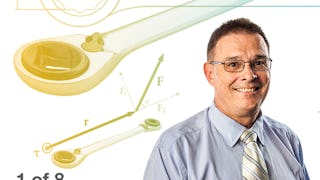
Georgia Institute of Technology
Skills you'll gain: Engineering Analysis, Mechanics, Torque (Physics), Engineering Calculations, Mechanical Engineering, Engineering, Engineering Practices, Structural Analysis, Mathematical Modeling, Applied Mathematics, Trigonometry
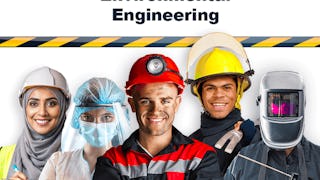
Khalifa University
Skills you'll gain: Environmental Management Systems, Environment Health And Safety, Environmental Monitoring, Accident Reporting, Fire And Life Safety, Accident Prevention, Hazardous Waste Operations And Emergency Response Standard (HAZWOPER), Environmental Regulations, Safety Assurance, Health And Safety Standards, Environmental Engineering, Environmental Laws, Environmental Resource Management, Risk Management, Risk Management Framework, Environmental Engineering and Restoration, Risk Analysis, Environment and Resource Management, Engineering Management, Engineering

University of Colorado Boulder
Skills you'll gain: Prompt Engineering, New Product Development, Sustainability Reporting, Model Based Systems Engineering, Model Evaluation, Generative AI, Agile Project Management, Sustainable Business, Data Mining, Field-Programmable Gate Array (FPGA), Delegation Skills, Strategic Decision-Making, Real-Time Operating Systems, Object Oriented Design, Sampling (Statistics), Failure Analysis, Data Ethics, Goal Setting, Database Design, Data Visualization

Dartmouth College
Skills you'll gain: Structural Analysis, Structural Engineering, Civil Engineering, Vibrations, Architectural Engineering, Engineering Calculations, Construction, Architecture and Construction, SketchUp (3D Modeling Software), Building Design, Mechanics, Engineering Analysis, Materials science, Mathematical Modeling, Failure Analysis, Construction Engineering, Engineering Design Process, Engineering, Design, 3D Modeling

Arizona State University
Skills you'll gain: Engineering Design Process, Engineering Drawings, Prototyping, Assembly Drawing, Product Design, Drafting and Engineering Design, Product Development, Hardware Design, Technical Drawing

What brings you to Coursera today?

Birla Institute of Technology & Science, Pilani
Skills you'll gain: Data Analysis, Computational Logic, Integral Calculus, Trigonometry, Linear Algebra, Engineering Analysis, Logical Reasoning, Deductive Reasoning, Probability & Statistics, Statistical Analysis, Calculus, Statistical Methods, Analysis, Advanced Mathematics, Bayesian Statistics, Statistical Inference, Theoretical Computer Science, Mathematics and Mathematical Modeling, Numerical Analysis, Descriptive Analytics

Skills you'll gain: Prompt Engineering, Prompt Patterns, ChatGPT, Generative AI, LLM Application, AI literacy, Model Evaluation, Image Quality

Skills you'll gain: Prompt Engineering, Apache Spark, Large Language Modeling, Retrieval-Augmented Generation, PyTorch (Machine Learning Library), Computer Vision, Unsupervised Learning, Generative Model Architectures, Prompt Patterns, Generative AI, PySpark, Model Optimization, Keras (Neural Network Library), Supervised Learning, LLM Application, Vector Databases, Fine-tuning, Machine Learning, Python Programming, Data Science

Rice University
Skills you'll gain: Cost Estimation, Project Scoping, Communication Planning, Cost Management, Engineering Management, Scope Management, Project Estimation, Project Schedules, Earned Value Management, Team Management, Quality Assurance, Stakeholder Management, Team Performance Management, Risk Management, Organizational Structure, Project Documentation, Stakeholder Engagement, Project Management, Procurement, Planning

Skills you'll gain: Prompt Engineering, Prompt Patterns, Unit Testing, Large Language Modeling, LangChain, Generative AI, Retrieval-Augmented Generation, Data Wrangling, Responsible AI, Exploratory Data Analysis, Unsupervised Learning, Model Evaluation, Generative Model Architectures, PyTorch (Machine Learning Library), LLM Application, Keras (Neural Network Library), Supervised Learning, Vector Databases, Fine-tuning, Data Import/Export

MathWorks
Skills you'll gain: Model Based Systems Engineering, Systems Engineering, Systems Architecture, Systems Design, Functional Design, Requirements Analysis, System Requirements, Requirements Elicitation, Functional Requirement, Verification And Validation

Skills you'll gain: Software Development Life Cycle, Software Architecture, Full-Stack Web Development, Software Design, Web Development, Software Development Methodologies, Software Design Patterns, Development Environment, Unified Modeling Language, Software Engineering, Web Applications, Software Development Tools, Software Development, Application Deployment, Programming Principles, Front-End Web Development, Web Language, Back-End Web Development, Integrated Development Environments, Python Programming
What brings you to Coursera today?
Best free Engineering courses
High-quality free Engineering courses you can start today.
- Introduction to Engineering MechanicsGeorgia Institute of TechnologyMixed1 - 3 MonthsFree
- Systems EngineeringMathWorksBeginner1 - 4 WeeksFree
Best Engineering courses from IBM
Top-rated Engineering courses offered by IBM on Coursera.
- Generative AI: Prompt Engineering BasicsIBMBeginner1 - 4 WeeksIBM
- IBM AI EngineeringIBMIntermediate3 - 6 MonthsIBM
- IBM Generative AI EngineeringIBMBeginner3 - 6 MonthsIBM
Best Engineering certificate programs
Earn a certificate in Engineering from top universities and companies.
- Health, Safety, and Environmental (HSE) EngineeringKhalifa UniversityBeginner1 - 3 MonthsSpecialization
- The Engineering of Structures Around UsDartmouth CollegeBeginner3 - 6 MonthsSpecialization
- Mathematics for EngineeringBirla Institute of Technology & Science, PilaniBeginner3 - 6 MonthsSpecialization
Best Engineering courses for beginners
Top-rated beginner-friendly Engineering courses with no prerequisites.
- Engineering and Product Design ProcessesArizona State UniversityBeginner1 - 4 WeeksNo prerequisites
- Engineering Project ManagementRice UniversityBeginner3 - 6 MonthsNo prerequisites
- Introduction to Software EngineeringIBMBeginner1 - 3 MonthsNo prerequisites










