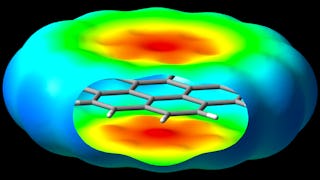
Advanced Chemistry courses can help you learn reaction mechanisms, thermodynamics, molecular structure, and spectroscopy techniques. You can build skills in laboratory techniques, data analysis, and critical thinking in experimental design. Many courses introduce tools such as chromatography, mass spectrometry, and computational chemistry software, that support analyzing chemical compounds and predicting molecular behavior.
Rice University
★ 4.7 (1.4K) · Mixed · Course

University of Manchester
Skills you'll gain: Chemistry, Laboratory Experience, Experimentation

★ 4.7 (760) · Mixed · Course · 1 - 3 Months

Technion - Israel Institute of Technology
Skills you'll gain: Materials science, Semiconductors, Innovation, Chemistry, Electrical Engineering

★ 4.6 (1.2K) · Mixed · Course · 1 - 3 Months

Skills you'll gain: Microsoft Excel, Excel Formulas, Data Visualization, Interactive Data Visualization, Dashboard, Forecasting, Analytics, Advanced Analytics, Business Analytics, Data Analysis, Data Validation, Analysis, Data Management, Data Integrity, Data Security, Decision Making
★ 4.8 (38) · Mixed · Course · 1 - 3 Months

Yonsei University
Skills you'll gain: Materials science, Manufacturing Processes, Physics
★ 4.7 (161) · Mixed · Course · 1 - 3 Months

Skills you'll gain: Microsoft Excel, Excel Macros, Excel Formulas, Spreadsheet Software, Workflow Management, Data Analysis, Automation, Analysis, Operational Efficiency, Decision Making

★ 5 (14) · Mixed · Course · 1 - 4 Weeks

Lecturio
Skills you'll gain: Biochemistry, Cell Biology, Physiology, Molecular Biology, Chemistry

Mixed · Course · 1 - 3 Months

University of California, Irvine
Skills you'll gain: Literacy, Writing, Peer Review, Honesty, Style Guides

★ 4.7 (2K) · Mixed · Course · 1 - 3 Months

Alex Genadinik
Skills you'll gain: Empathy, Empathy & Emotional Intelligence, Creativity, Self-Awareness, Emotional Intelligence
Mixed · Course · 1 - 3 Months
Ludwig-Maximilians-Universität München (LMU)
Skills you'll gain: Mergers & Acquisitions, Customer Retention, Business Strategy, Growth Strategies, Business Strategies, Regulation and Legal Compliance, Law, Regulation, and Compliance, Strategic Thinking, Strategic Partnership, Regulatory Compliance, Product Strategy, Marketing

★ 4.7 (884) · Mixed · Course · 1 - 3 Months

Yale University
Skills you'll gain: Negotiation, Case Studies, Persuasive Communication, Influencing, Game Theory, Collaboration, Strategic Decision-Making

★ 4.8 (5.2K) · Mixed · Course · 1 - 3 Months

University of California, Davis
Skills you'll gain: Chemical Engineering, Hazard Analysis, Predictive Modeling, Engineering Calculations, Mathematical Modeling, Estimation
★ 4.6 (64) · Mixed · Course · 1 - 4 Weeks
High-quality free Advanced Chemistry courses you can start today.
Top-rated Advanced Chemistry courses offered by EDUCBA on Coursera.
Advanced chemistry is a branch of chemistry that focuses on complex concepts and applications, often involving the study of molecular interactions, reaction mechanisms, and the development of new materials. Understanding advanced chemistry is crucial as it plays a significant role in various fields, including pharmaceuticals, environmental science, and materials engineering. By grasping advanced chemistry principles, you can contribute to innovations that address global challenges, such as drug development and sustainable materials.a‎
A background in advanced chemistry opens up a variety of career opportunities. You might find roles in research and development, quality control, or regulatory affairs within industries such as pharmaceuticals, biotechnology, and environmental science. Positions like research scientist, chemical engineer, and laboratory technician are common pathways. Additionally, advanced chemistry skills are valuable in academia, where you can engage in teaching and research.‎
To excel in advanced chemistry, you should focus on developing a strong foundation in fundamental chemistry concepts, including organic, inorganic, and physical chemistry. Skills in analytical techniques, laboratory practices, and data analysis are also essential. Familiarity with software tools for modeling and simulation can enhance your capabilities. Furthermore, critical thinking and problem-solving skills will help you tackle complex chemical problems effectively.‎
There are several online courses available for those interested in advanced chemistry. Look for programs that cover topics such as advanced organic chemistry, chemical kinetics, and materials science. While specific courses may vary, platforms like Coursera offer a range of options that cater to different interests and career goals. Exploring these courses can help you find the right fit for your learning journey.‎
Yes. You can start learning advanced chemistry on Coursera for free in two ways:
If you want to keep learning, earn a certificate in advanced chemistry, or unlock full course access after the preview or trial, you can upgrade or apply for financial aid.‎
Learning advanced chemistry involves a combination of theoretical study and practical application. Start by reviewing foundational concepts and gradually progress to more complex topics. Engage with online courses, participate in discussions, and practice problem-solving. Utilizing laboratory resources, whether virtual or in-person, can enhance your understanding. Consistent practice and seeking help when needed will reinforce your learning.‎
Typical topics covered in advanced chemistry courses include reaction mechanisms, thermodynamics, spectroscopy, and materials science. You may also explore specialized areas such as biochemistry, polymer chemistry, and nanotechnology. These subjects provide a comprehensive understanding of chemical principles and their applications in real-world scenarios.‎
For training and upskilling employees in advanced chemistry, look for courses that focus on practical applications and industry-relevant skills. Programs that integrate hands-on laboratory experiences and real-world case studies can be particularly beneficial. Consider options like the Google Advanced Data Analytics Professional Certificate or the SAS Advanced Programmer Professional Certificate to enhance analytical and programming skills that complement advanced chemistry knowledge.‎