Acoustics Courses
Acoustics courses can help you learn sound wave properties, sound measurement techniques, and noise control strategies. You can build skills in audio analysis, room acoustics design, and environmental noise assessment. Many courses introduce tools like sound level meters, acoustic modeling software, and digital audio workstations, showing how these instruments are used to evaluate and manipulate sound in various environments.
Popular Acoustics Courses and Certifications

Korea Advanced Institute of Science and Technology(KAIST)
Skills you'll gain: Vibrations, Mechanics, Systems Of Measurement, Engineering Analysis, Differential Equations, Physics, Calculus, Applied Mathematics, Mathematical Modeling, Trigonometry
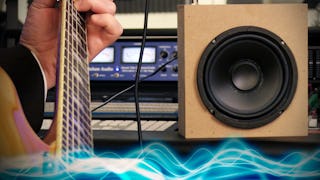 Status: Preview
University of Rochester
Skills you'll gain: Basic Electrical Systems, Music, Electrical Engineering, Electronics, Electronic Components, Electronic Hardware, Electronics Engineering, Electronic Systems, Music Theory, Electrical Systems, Hardware Design, Electrical Wiring, Vibrations, General Construction and Construction Labor, Engineering Analysis, Engineering Calculations
Korea Advanced Institute of Science and Technology(KAIST)
Skills you'll gain: Vibrations, Architectural Design, Engineering Analysis, Engineering Calculations, Mathematical Modeling, Integral Calculus, Applied Mathematics, Differential Equations, Calculus
 Status: Free Trial
Rice University
Skills you'll gain: Physics, Mechanics, electromagnetics, Vibrations, Materials science, Applied Mathematics, Physical Science, Mathematical Modeling, Advanced Mathematics, Calculus, Differential Equations, Trigonometry, Linear Algebra, Integral Calculus, Problem Solving
 Status: NewStatus: Free Trial
Coursera
Skills you'll gain: Apache Airflow, Model Optimization, Data Validation, Image Analysis, Transfer Learning, Data Preprocessing, Data Integrity, Model Evaluation, Debugging, Computer Vision, PyTorch (Machine Learning Library), Data Pipelines, Feature Engineering, MLOps (Machine Learning Operations), Tensorflow, Model Training, Embeddings, Performance Tuning, Deep Learning, Digital Signal Processing
 Status: Free Trial
Berklee
Skills you'll gain: Music Theory, Music, Instrumental Music, Music Performance
What brings you to Coursera today?
 Status: Preview
École Polytechnique
Skills you'll gain: Vibrations, Mechanics, Engineering Analysis, Mathematical Modeling, Structural Analysis, Mechanical Engineering, Civil Engineering
 Status: Free Trial
Rice University
Skills you'll gain: Physics, electromagnetics, Materials science, Physical Science, Mathematical Modeling, Advanced Mathematics, Linear Algebra, Applied Mathematics, Problem Solving
 Status: Free Trial
Icahn School of Medicine at Mount Sinai
Skills you'll gain: Sensory Systems Analysis, Anatomy, Communication Disorders, Pathology, Physiology, Patient Treatment
 Status: Preview
Korea Advanced Institute of Science and Technology(KAIST)
Skills you'll gain: Vibrations, Matlab, Engineering Analysis, Mechanical Engineering, Mechanical Design, Mathematical Software, Applied Mathematics, Mechanics, Differential Equations, Mathematical Modeling, Control Systems
 Status: NewStatus: Preview
Coursera
Skills you'll gain: Vibrations, Equipment Design, Engineering Analysis, Mechanical Design, Mechanical Engineering, Materials science, Material Handling, Industrial Engineering, Design, Analysis, Application Development
 Status: Free
Universitat Pompeu Fabra of Barcelona
Skills you'll gain: Digital Signal Processing, Music, Open Source Technology, Python Programming, Applied Mathematics, Classification Algorithms, Algorithms
In summary, here are 10 of our most popular acoustics courses
- Intro to Acoustics (Part 1): Korea Advanced Institute of Science and Technology(KAIST)
- Fundamentals of Audio and Music Engineering: Part 1 Musical Sound & Electronics: University of Rochester
- Introduction to Acoustics (Part 2): Korea Advanced Institute of Science and Technology(KAIST)
- Physics of Waves and Optics: Rice University
- Vision & Audio AI Systems: Coursera
- Guitar for Beginners: Berklee
- Fundamentals of waves and vibrations: École Polytechnique
- Physics of Light and Materials: Rice University
- Introduction to Hearing Loss: Icahn School of Medicine at Mount Sinai
- Mechanical Vibration: Korea Advanced Institute of Science and Technology(KAIST)










