Data Engineering Courses
Data engineering courses can help you learn data modeling, ETL (extract, transform, load) processes, and data warehousing techniques. You can build skills in data pipeline construction, database management, and ensuring data quality and integrity. Many courses introduce tools like Apache Spark, Hadoop, and SQL, that support processing large datasets and optimizing data workflows. You’ll also explore cloud platforms such as AWS and Azure, which facilitate scalable data solutions and enhance your ability to manage data in various environments.
Popular Data Engineering Courses and Certifications

Duke University
Skills you'll gain: MySQL, Bash (Scripting Language), Scripting, Database Management, Relational Databases, Command-Line Interface, SQL, Databases, Data Import/Export, Database Application, Data Pipelines, Data Manipulation, Python Programming, Linux

Coursera
Skills you'll gain: Applied Machine Learning, Jupyter, Machine Learning Algorithms, Model Evaluation, Machine Learning, Predictive Modeling, Data Science, Python Programming, Predictive Analytics, Data Analysis, Technical Communication
Skills you'll gain: Pandas (Python Package), NumPy, Data Analysis, Data Science, Python Programming, Data Structures, Exploratory Data Analysis, Data Manipulation, Computer Programming
Skills you'll gain: PySpark, Apache Spark, Data Visualization Software, Data Analysis, Exploratory Data Analysis, Data Cleansing, Data Processing, Data Manipulation, Big Data, Jupyter, Pandas (Python Package), People Analytics
Skills you'll gain: Data Analysis Expressions (DAX), Power BI, Business Analysis, Financial Data, Business Intelligence, Data Modeling, Financial Analysis, Time Series Analysis and Forecasting, Data Visualization, Data Import/Export
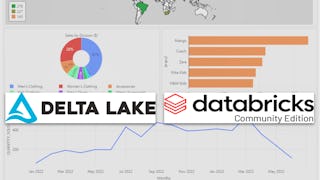
Skills you'll gain: Databricks, Data Lakes, Data Pipelines, Data Integration, Dashboard, PySpark, SQL, Apache Spark, Data Management, Data Transformation, Version Control
What brings you to Coursera today?
Skills you'll gain: Microsoft Azure, Data Transformation, Data Pipelines, Data Flow Diagrams (DFDs), Extract, Transform, Load, Dataflow, Data Storage Technologies, Data Integration, Data Storage
Skills you'll gain: Plotly, Histogram, Interactive Data Visualization, Scatter Plots, Plot (Graphics), Data Visualization, Data Analysis, Python Programming
Coursera
Skills you'll gain: Web Scraping, Relational Databases, Statistical Software, Data Import/Export, R Programming, MySQL, Data Capture, Microsoft Excel

Skills you'll gain: Data-Driven Decision-Making, Data Visualization, Business Analytics, Data Analysis, Data Cleansing, Statistical Analysis, Data Preprocessing, Exploratory Data Analysis, Matplotlib, Customer Analysis, Analytical Skills, Trend Analysis, Pandas (Python Package), Python Programming, Jupyter

Skills you'll gain: Presentations, Sales Presentations, Sales Presentation, Data Visualization, Productivity Software, Design
Skills you'll gain: Google Analytics, Web Analytics, Content Performance Analysis, Marketing Analytics, Dashboard, User Accounts
In summary, here are 10 of our most popular data engineering courses
- MySQL-for-Data-Engineering: Duke University
- Data Science Challenge: Coursera
- Python for Data Analysis: Pandas & NumPy: Coursera
- PySpark Foundations: Process, analyze, and summarize data: Coursera
- Data Modeling with Power BI: Advanced DAX Calculations : Coursera
- Data Management with Databricks: Big Data with Delta Lakes: Coursera
- Create Mapping Data Flows in Azure Data Factory: Coursera
- Crash Course on Interactive Data Visualization with Plotly: Coursera
- Importing Data into R: Coursera
- Perform exploratory data analysis on retail data with Python: Coursera










