R Courses
R courses can help you learn data manipulation, statistical analysis, data visualization, and programming fundamentals. You can build skills in creating reproducible research, performing regression analysis, and implementing machine learning algorithms. Many courses introduce tools like RStudio and packages such as ggplot2 and dplyr, which enhance your ability to analyze datasets and present findings effectively.
Popular R Courses and Certifications
Coursera
Skills you'll gain: R (Software), Data Import/Export, Package and Software Management, R Programming, Data Structures, Data Analysis Software, Data Analysis, Data Science

Skills you'll gain: R (Software), R Programming, Arithmetic, Statistical Programming, Development Environment, Programming Principles, Data Import/Export
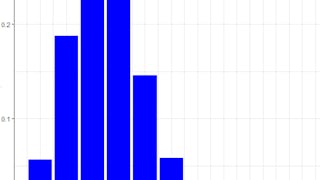
Skills you'll gain: Statistical Inference, Probability Distribution, R Programming, Statistical Visualization, R (Software), Data Visualization, Statistical Analysis, Statistical Hypothesis Testing, Data Analysis, Probability
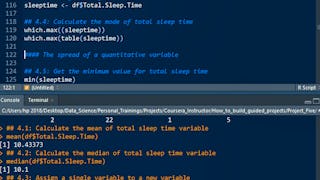
Skills you'll gain: Descriptive Statistics, Data Analysis, R Programming, Statistical Analysis, R (Software), Statistical Methods, Statistics, Data Science
Coursera
Skills you'll gain: Interactive Data Visualization, Plot (Graphics), R (Software), Software Installation, Package and Software Management, R Programming, Integrated Development Environments
What brings you to Coursera today?
Skills you'll gain: Descriptive Statistics, Statistical Programming, R Programming, R (Software), Statistical Reporting, Data Quality, Data Preprocessing, Statistics, Data Import/Export
Skills you'll gain: Feature Engineering, Model Evaluation, Predictive Modeling, Model Deployment, Model Training, R Programming, Data Analysis, Data Cleansing, Data Manipulation, Classification Algorithms, Data Import/Export, Data Preprocessing, Machine Learning
Coursera
Skills you'll gain: Ggplot2, Plot (Graphics), Data Cleansing, Data Transformation, Data Visualization, R Programming, Data Manipulation, Data Analysis, Data Management

Skills you'll gain: Python Programming, Command-Line Interface, Programming Principles, Computer Programming, Computer Programming Tools, Program Development
Skills you'll gain: Prompt Engineering, OpenAI API, Education Software and Technology, Generative AI, AI Integrations, OpenAI, Scripting, Python Programming, Application Programming Interface (API), Application Development, Machine Learning, Software Engineering
Skills you'll gain: API Testing, Postman API Platform, OAuth, Application Programming Interface (API), Performance Testing, Security Testing, Software Testing


Skills you'll gain: No-Code Development, Mobile Development, Google Sheets, Application Development, Mobile Development Tools, Application Design, Application Deployment, Development Testing, Spreadsheet Software, Data Structures, User Interface (UI), User Accounts, Authentications, Web Development, Marketing
Best free R Programming courses
High-quality free R Programming courses you can start today.
- Create Your First Python Program From USTCourseraBeginnerLess Than 2 HoursFree
- Build a mobile app with Google Sheets on Glide and no codingCourseraBeginnerLess Than 2 HoursFree
Best R Programming courses from Coursera
Top-rated R Programming courses offered by Coursera on Coursera.
- Getting Started with RCourseraBeginnerLess Than 2 HoursCoursera
- Introduction to R: Basic R syntaxCourseraBeginnerLess Than 2 HoursCoursera
- Using probability distributions for real world problems in RCourseraBeginnerLess Than 2 HoursCoursera
Best R Programming courses for beginners
Top-rated beginner-friendly R Programming courses with no prerequisites.
- Calculating Descriptive Statistics in RCourseraBeginnerLess Than 2 HoursNo prerequisites
- Getting Started with RstudioCourseraBeginnerLess Than 2 HoursNo prerequisites
- Using Descriptive Statistics to Analyze Data in RCourseraBeginnerLess Than 2 HoursNo prerequisites
Best short R Programming courses
Quick R Programming courses you can complete in a few hours or less.
- Build and deploy a stroke prediction model using RCourseraIntermediateLess Than 2 HoursQuick completion
- Tidy Messy Data using tidyr in RCourseraIntermediateLess Than 2 HoursQuick completion
- Prompt Engineering with GPT: Programming for Custom ContentCourseraIntermediateLess Than 2 HoursQuick completion










