Linear Regression Courses
Linear regression courses can help you learn how to analyze relationships between variables, interpret coefficients, and evaluate model performance. You can build skills in data visualization, hypothesis testing, and making predictions based on data trends. Many courses introduce tools like Python, R, and Excel, that support implementing regression models and analyzing datasets effectively.
Popular Linear Regression Courses and Certifications
Coursera
Skills you'll gain: Model Training, Regression Analysis, NumPy, Machine Learning Algorithms, Machine Learning, Model Optimization, Deep Learning, Data Science, Python Programming
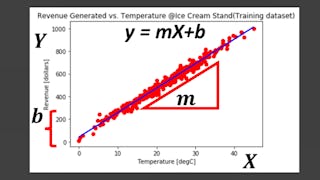
Skills you'll gain: Scientific Visualization, Data Preprocessing, Regression Analysis, Scikit Learn (Machine Learning Library), Feature Engineering, Data Cleansing, Predictive Modeling, Data Analysis, Statistical Modeling, Model Training, Statistical Methods, Supervised Learning, Model Evaluation, Machine Learning, Python Programming

Skills you'll gain: Regression Analysis, Statistical Hypothesis Testing, Logistic Regression, Statistical Analysis, Statistical Methods, Correlation Analysis, Predictive Modeling, Supervised Learning, Predictive Analytics, Statistical Modeling, Machine Learning, Model Evaluation, Variance Analysis, Python Programming
 Status: Top AI Program
DeepLearning.AI
Skills you'll gain: Supervised Learning, Applied Machine Learning, Jupyter, Scikit Learn (Machine Learning Library), Machine Learning, Model Training, NumPy, Machine Learning Algorithms, Predictive Modeling, Classification Algorithms, Feature Engineering, Artificial Intelligence, Model Evaluation, Data Preprocessing, Python Programming, Logistic Regression, Model Optimization, Regression Analysis, Algorithms
Skills you'll gain: Scikit Learn (Machine Learning Library), Predictive Modeling, Regression Analysis, Machine Learning Algorithms, Applied Machine Learning, Predictive Analytics, Python Programming, Classification Algorithms, Model Training, Machine Learning, Data Analysis
Skills you'll gain: Data Wrangling, Exploratory Data Analysis, Data Analysis, Data Import/Export, Data Manipulation, Data Transformation, Predictive Modeling, Data Cleansing, Data Preprocessing, Model Evaluation, Data Processing, Data Science, Predictive Analytics, Model Training, Analytics, Model Optimization, Pandas (Python Package), Statistical Modeling, Data Visualization, Python Programming
What brings you to Coursera today?

University of Michigan
Skills you'll gain: Logistic Regression, Forecasting, Statistical Methods, Exercise Science, Regression Analysis, Plot (Graphics), Data Cleansing, Scikit Learn (Machine Learning Library), Supervised Learning, Data Processing, Statistical Hypothesis Testing, Correlation Analysis, Predictive Analytics, Applied Machine Learning, Injury Prevention, Athletic Training, Analytics, People Analytics, Data Analysis, Python Programming
 Status: Job Ready
Skills you'll gain: Data Storytelling, Data Visualization, A/B Testing, Sampling (Statistics), Data Analysis, Exploratory Data Analysis, Regression Analysis, Data Visualization Software, Data Presentation, Data Ethics, Feature Engineering, Statistical Hypothesis Testing, Analytics, Statistical Analysis, Data Science, Tableau Software, Machine Learning, Object Oriented Programming (OOP), Web Presence, Python Programming

Skills you'll gain: Python Programming, Algorithms, Computer Programming, Theoretical Computer Science, Linear Algebra, Mathematics and Mathematical Modeling, Computer Science, Algebra, Object Oriented Programming (OOP), IBM Cloud, Scripting, Probability, Artificial Intelligence and Machine Learning (AI/ML), Data Processing, Mathematical Modeling, Data Structures, Data Manipulation, Probability & Statistics, Applied Mathematics, Software Installation

Skills you'll gain: Plotly, PyTorch (Machine Learning Library), NumPy, Matplotlib, Pandas (Python Package), Plot (Graphics), Data Visualization Software, Interactive Data Visualization, Machine Learning Methods, Python Programming, Applied Machine Learning, Scatter Plots, Numerical Analysis, Data Manipulation, Deep Learning, Image Analysis, Linear Algebra, Data Wrangling

University of Pittsburgh
Skills you'll gain: Statistical Analysis, NumPy, Probability Distribution, Matplotlib, Plot (Graphics), Statistics, Data Science, Probability & Statistics, Probability, Statistical Modeling, Predictive Modeling, Data Analysis, Linear Algebra, Predictive Analytics, Statistical Methods, Mathematics and Mathematical Modeling, Applied Mathematics, Python Programming, Machine Learning, Logical Reasoning

Duke University
Skills you'll gain: Responsible AI, Large Language Modeling, Data Ethics, Decision Tree Learning, Regression Analysis, Generative AI, Artificial Intelligence, AI literacy, Decision Intelligence, Applied Machine Learning, Generative Model Architectures, Statistical Modeling, Python Programming, Machine Learning, Model Evaluation, Embeddings, Image Analysis, Machine Learning Methods, Scientific Visualization, Deep Learning
In summary, here are 10 of our most popular linear regression courses
- Linear Regression with Python: Coursera
- Simple Linear Regression for the Absolute Beginner: Coursera
- Regression Analysis: Simplify Complex Data Relationships: Google
- Supervised Machine Learning: Regression and Classification : DeepLearning.AI
- Scikit-Learn to Solve Regression Machine Learning Problems: Coursera
- Data Analysis with Python: IBM
- Sports Performance Analytics: University of Michigan
- Google Advanced Data Analytics: Google
- The Complete Quantum Computing Course for Beginners: Packt
- Data Science with Python: Packt










